
Spiritual stories
Bala Kanda: The Childhood and Early Journey of Shri Rama
Explore the opening book of the Valmiki Ramayana: the origin of the epic, Rama's birth and youth, Vishvamitra's guidance, the protection of the sages, the journey to Mithila, and the marriage of Rama and Sita.
Introduction: The Beginning of the Ramayana
Bala Kanda, the first book of the Valmiki Ramayana, introduces the principal figures and ideals of the epic. The word bala is associated with childhood and youth, and this Kanda follows Rama from the circumstances surrounding his birth through the events that lead to his marriage with Sita.
The book also tells of the Ramayana's poetic beginning. Valmiki asks Narada whether there is a person who embodies virtue, courage, gratitude, truthfulness, self-control and concern for others. Narada describes Rama and recounts the broad course of his life. The traditional account of Valmiki's encounter with the sorrow of a bird, followed by Brahma's appearance, connects compassion with the birth of the epic poem.
Ayodhya and King Dasharatha
Ayodhya is presented as the prosperous capital of the Ikshvaku dynasty. Its ruler, King Dasharatha, is respected for his strength, generosity and commitment to royal responsibilities. Yet he is troubled because he has no son to continue the dynasty.
Guided by sages and advisers, Dasharatha undertakes the rites described in the epic, including the horse sacrifice and the Putrakameshti ceremony performed with the participation of Rishyasringa. The sacred ceremony prepares the way for the birth of the royal heirs.
The Birth and Childhood of the Four Princes
After the ceremony, Dasharatha receives a divine offering and distributes it among his queens. Kausalya gives birth to Rama, Kaikeyi to Bharata, and Sumitra to Lakshmana and Shatrughna. Their births bring great joy to Ayodhya and fulfil the king's long-held hope.
The four princes grow up under the care of their family and teachers. Rama and Lakshmana share a close bond, as do Bharata and Shatrughna. Their education and discipline prepare them for the duties that await them beyond the palace.
Vishvamitra's Arrival and the Princes' First Mission
Sage Vishvamitra visits Dasharatha's court and asks that Rama accompany him to protect a sacred rite from rakshasas who disrupt the sages' observances. Dasharatha hesitates to send his young son into danger, but Vashishtha counsels the king to honour the sage's request.
Rama sets out with Lakshmana. Vishvamitra teaches the princes sacred knowledge and the use of powerful weapons. Rama confronts Tataka and later protects the sacrifice at Siddhashrama, defeating the forces led by Maricha and Subahu. These events mark Rama's first major mission beyond the royal household.
Sacred Places, Ahalya and the Journey to Mithila
As the journey continues, Vishvamitra narrates accounts associated with the regions they cross, including stories of ancient lineages, sacred places and the Ganga. These embedded narratives connect the princes' journey with the memory of earlier sages and generations.
At the hermitage associated with Gautama, Rama's arrival brings about Ahalya's restoration in the Valmiki narrative. Later retellings present this episode with differing details, so the Valmiki account should be distinguished from subsequent devotional versions.
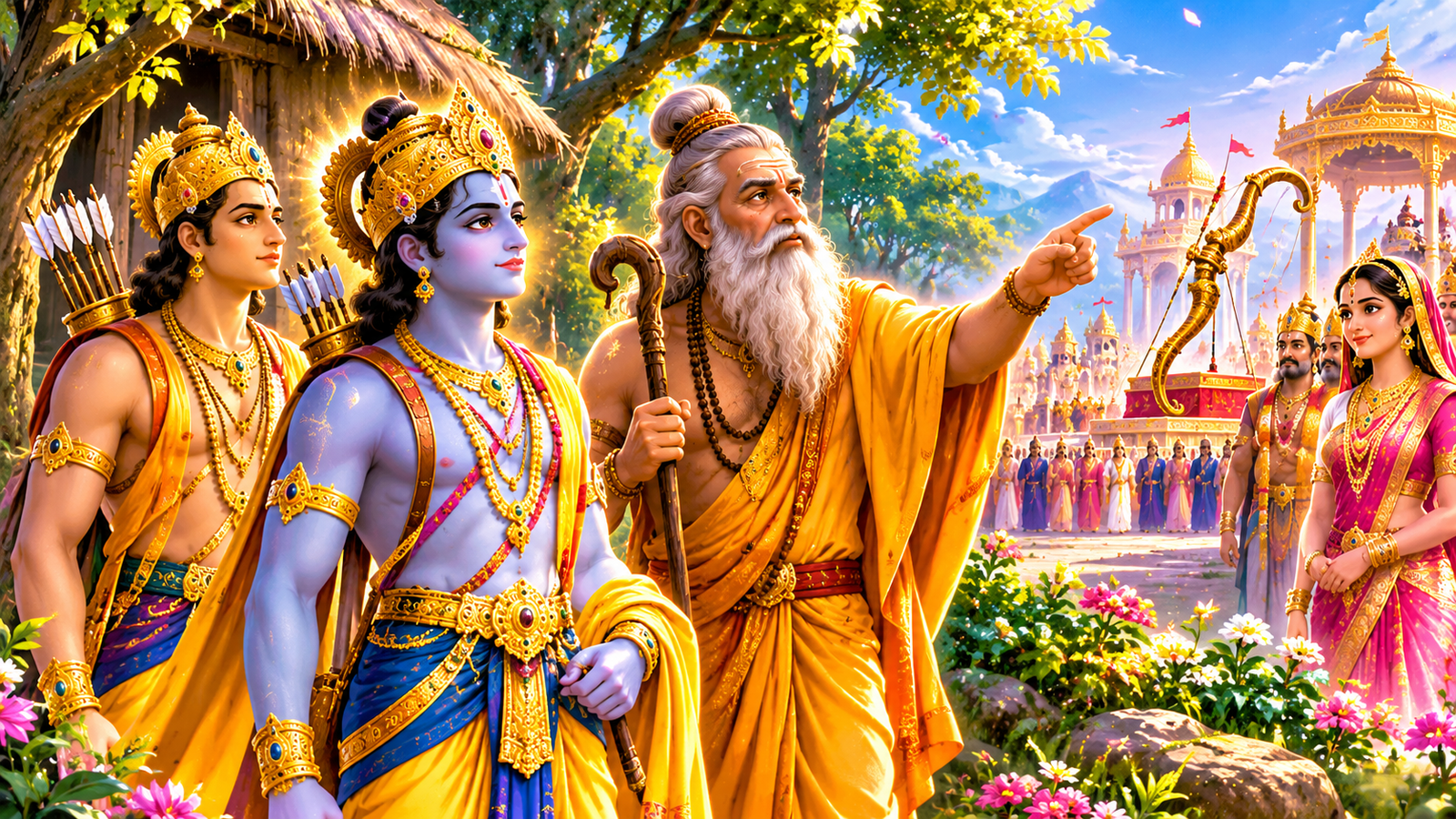
Vishvamitra then leads Rama and Lakshmana to Mithila, ruled by King Janaka. Janaka welcomes the sage and the princes and tells them about the great bow of Shiva preserved by his lineage.
Sita and the Bow of Shiva
The narrative tells that Janaka found Sita while preparing the sacrificial ground and raised her as his daughter. When she came of age, he declared that the man able to lift and string the extraordinary bow of Shiva would be worthy of marrying her.
Many kings and princes had tried and failed. At Janaka's assembly, Rama approaches the bow at Vishvamitra's direction. He lifts it and, as he attempts to string it, the mighty bow breaks with a tremendous sound. Janaka recognises that Rama has fulfilled the condition and agrees to the marriage.
The Four Royal Weddings
Messengers are sent to Ayodhya, and Dasharatha travels to Mithila with his family and advisers. The marriages unite the royal houses of Ayodhya and Mithila: Rama marries Sita, Lakshmana marries Urmila, Bharata marries Mandavi, and Shatrughna marries Shrutakirti.
The weddings are celebrated with the participation of sages and royal families. They conclude the central movement of Bala Kanda and bring together the principal young characters whose relationships shape the later books.
The Encounter with Parashurama
As the wedding party returns from Mithila, the powerful sage-warrior Parashurama appears. Having heard that Shiva's bow has been broken, he challenges Rama and presents another divine bow associated with Vishnu. Rama accepts the challenge and strings it.
Parashurama recognises Rama's extraordinary nature and withdraws. The episode closes Bala Kanda by signalling that Rama's journey is larger than the celebrations of his marriage; the responsibilities and trials of his life still lie ahead.
Key Characters
Rama is the prince whose character and conduct become central to the epic. Lakshmana is his devoted companion. Dasharatha and the queens Kausalya, Kaikeyi and Sumitra form the royal family; Bharata and Shatrughna are Rama's brothers.
Vishvamitra guides the princes into the wider world of sages and sacred duties, while Vashishtha advises the royal household. King Janaka is Sita's father and the ruler of Mithila. Rishyasringa, Ahalya, Gautama and Parashurama are among the other important figures in this Kanda.
Teachings and Reflections
Guidance and learning: Rama's journey with Vishvamitra highlights the value of learning from an experienced teacher and applying knowledge in service of a wider responsibility.
Courage with discipline: Rama's strength is used to protect the sages and their sacred work, not for personal glory.
Responsibility beyond privilege: The princes move beyond palace life and encounter duties that require restraint, courage and service.
Compassion and poetry: The traditional account of Valmiki's first śloka links poetic expression with an encounter with grief, reminding readers that sensitivity to suffering can inspire meaningful speech and art.
Commitment and partnership: The marriage of Rama and Sita is a significant bond between two royal houses and introduces a partnership central to the unfolding epic.
Bala Kanda in the Wider Ramayana
Bala Kanda establishes the people, places and values developed in later books. Rama's early encounters with sages prepare the reader for his forest life; his bond with Sita becomes central to the events that follow; and the close relationship between Rama and Lakshmana is already visible.
The Valmiki Ramayana is not identical to every work called a Ramayana. Tulsidas's Ramcharitmanas, Kamban's Ramavataram and many regional traditions retell the story in distinct literary, devotional and cultural settings. These versions deserve their own study and should not be silently merged into a summary of Valmiki's text.
Conclusion: The First Steps of Rama's Journey
From Valmiki's poetic beginning and the birth of the princes to Vishvamitra's guidance, the protection of the sages, the meeting with Sita and the marriages at Mithila, Bala Kanda lays the foundation of the Ramayana. It introduces Rama through his abilities as well as the relationships, guidance and responsibilities that shape his life.
The story now moves towards Ayodhya Kanda, where Rama's commitment to dharma will be tested amid the demands of family, kingship and a difficult promise.