
Spiritual stories
Ayodhya Kanda: Rama's Exile, Bharata's Devotion and the Test of Dharma
Explore the second book of the Valmiki Ramayana: the preparations for Rama's coronation, Kaikeyi's two boons, the fourteen-year exile, Dasharatha's grief, Bharata's refusal of the throne, and the meeting at Chitrakuta.
Introduction: The Turning Point in Rama's Life
Ayodhya Kanda, the second book of the Valmiki Ramayana, marks a decisive turning point. The story moves from the promise of Rama's coronation to his departure from the capital and the beginning of his forest exile. What appears at first to be a royal succession becomes a profound exploration of truth, duty, loyalty, grief and self-restraint.
The Kanda also gives Bharata a central place. His response to the events in Ayodhya reveals a form of devotion that does not seek power or personal advantage. Through the choices of Rama, Sita, Lakshmana, Dasharatha and Bharata, the narrative asks what it means to uphold dharma when every available path carries pain.
Ayodhya and the Decision to Crown Rama
King Dasharatha has grown old and wishes to see his eldest son, Rama, installed as heir apparent. Rama is loved by the people and respected for his conduct, courage, compassion and sense of responsibility. The king consults his advisers and the assembled leaders, and the proposal receives broad approval.
Preparations begin for the consecration. Ayodhya is filled with expectation and celebration, and the people look forward to Rama's rule. The joy of the city makes the reversal that follows especially painful: the ceremony is interrupted before it can take place.
Manthara and Kaikeyi's Two Boons
Kaikeyi initially hears of Rama's coming coronation without hostility. Manthara, her attendant, persuades her to see the succession as a threat to Bharata's future. Through repeated argument and fear, Manthara turns Kaikeyi away from the goodwill she had shown Rama.
Kaikeyi recalls that Dasharatha had once promised her two boons. She now demands that Bharata be crowned king and that Rama be sent into the forest for fourteen years. Dasharatha is devastated. Bound by his word, he cannot bring himself to withdraw the promise, even though fulfilling it means separation from the son he loves.
Rama Accepts the Exile
When Rama learns of the king's promise and Kaikeyi's demands, he does not respond with anger or a struggle for the throne. He accepts the exile as the means by which his father's word can be honoured. His composure does not mean that the decision is painless; it shows his determination to place duty above immediate personal comfort.
Sita refuses to remain in Ayodhya while Rama lives in the forest. She insists that their lives are joined and that she will share the hardships of exile. Lakshmana, deeply devoted to Rama, also chooses to accompany them. Their decision transforms the exile from one prince's departure into a separation that touches the whole royal family.
The Departure from Ayodhya
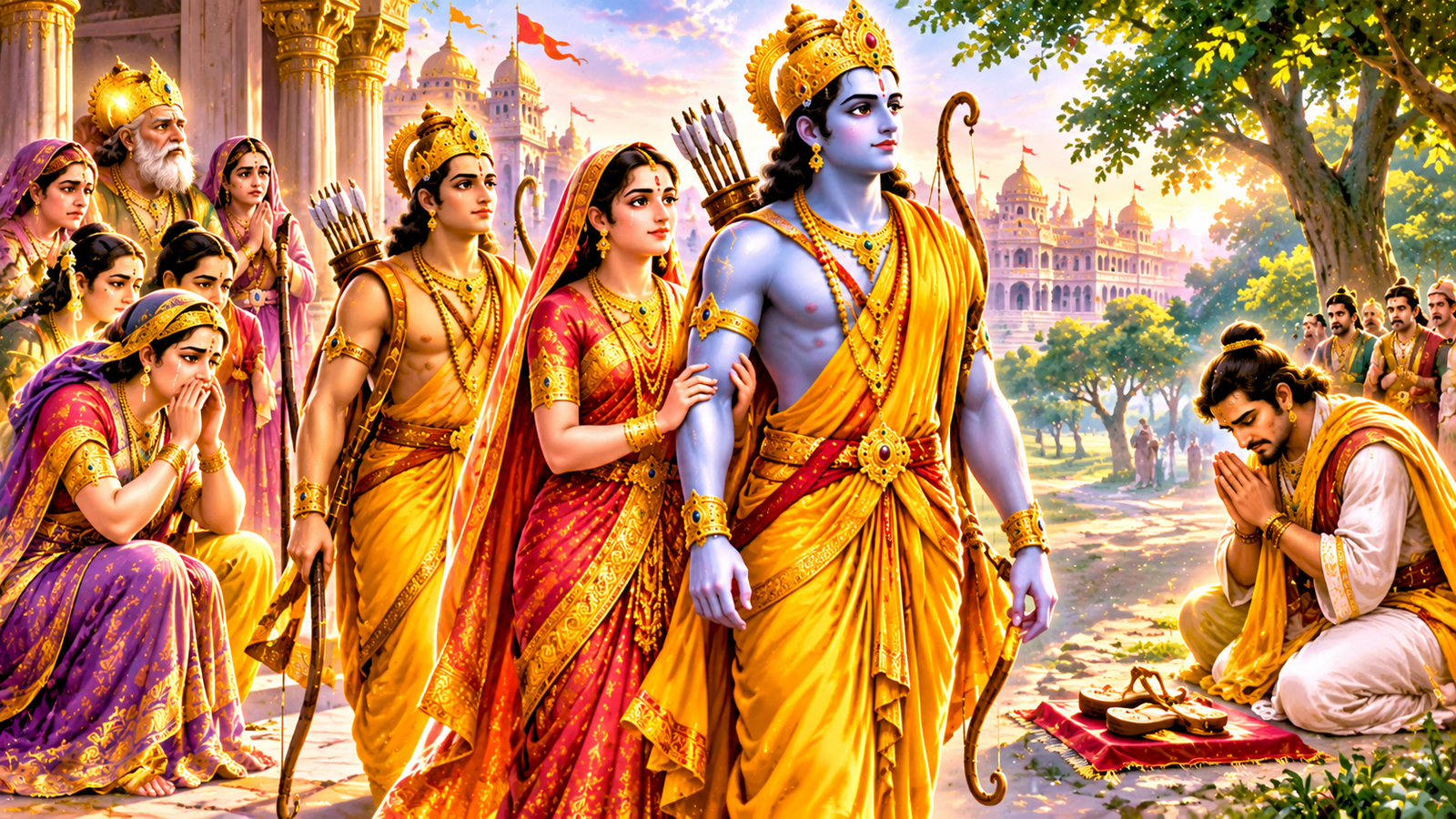
Rama, Sita and Lakshmana prepare to leave the palace in simple forest clothing. The people of Ayodhya are overcome with sorrow and follow them, unwilling to accept the departure of the prince they hoped would soon become their king. Sumantra drives the chariot, while the city is left in grief and confusion.
The journey takes the three into the countryside and toward the Ganga. At Shringaverapura they meet Guha, the Nishada chief, who welcomes Rama with affection and offers assistance. The travellers cross the river and continue into the forest. Rama also takes leave of Ayodhya in words that express his intention to return after completing the period of exile.
Dasharatha's Grief and Death
After Rama's departure, Dasharatha is overwhelmed by sorrow. His grief is intensified by the memory of an earlier incident in which, as a young prince, he unintentionally caused the death of a hermit's son. The father's account of that past deed and its consequences becomes part of the Kanda's reflection on action, responsibility and the results of one's choices.
Unable to bear separation from Rama, Dasharatha dies. His death leaves Ayodhya without its king at the very moment when the succession has been thrown into crisis. The royal household must now face both the loss of the father and the absence of the son who was to inherit the throne.
Bharata Returns and Rejects the Throne
Bharata and Shatrughna have been away from Ayodhya. When Bharata returns, he finds the city in mourning and learns from Kaikeyi that Dasharatha has died and Rama has been sent into exile. He is horrified by his mother's actions and condemns the attempt to secure the kingdom for him through Rama's banishment.
Bharata refuses to accept the throne as a reward for the injustice done to his brother. He makes clear that he did not seek the kingdom and that Rama is the rightful person to rule. His response is one of the Kanda's defining moments: he chooses loyalty and righteousness over the power that has been placed within his reach.
The Journey to Chitrakuta
Determined to bring Rama back, Bharata sets out toward the forest with members of the royal family, ministers and a large group from Ayodhya. Along the way, the party visits the hermitage of Sage Bharadvaja, who directs them toward Chitrakuta, where Rama is living with Sita and Lakshmana.
The meeting between the brothers is filled with emotion. Bharata asks Rama to return and take up the responsibilities of kingship. He argues that the kingdom and its people need their rightful ruler. The encounter is not a contest for authority; it is a conversation between brothers who each seek to honour what they understand as duty.
Rama and Bharata: Two Understandings of Duty
Rama explains that Dasharatha's promise must be fulfilled and that he cannot return before the fourteen years have ended. He urges Bharata to govern Ayodhya in the meantime. Bharata continues to plead, but he ultimately recognises that Rama will not abandon his commitment.
The sages and elders present discuss the matter, yet Rama remains firm. Bharata's devotion is shown not by forcing his own wish upon Rama, but by accepting his brother's decision while refusing to claim the throne as his personal possession. Their exchange gives Ayodhya Kanda one of its most enduring reflections on duty, truth and love within a family.
Rama's Sandals and Bharata's Stewardship
Bharata asks Rama for a token that can represent him in Ayodhya. Rama gives him his sandals. Bharata places them upon the throne as a sign that the kingdom belongs to Rama and that he will act only as its caretaker during the exile.
Bharata returns to Nandigrama and lives with restraint, awaiting Rama's return. He does not treat the period as an opportunity to enjoy royal privilege. The sandals become a powerful symbol of rightful authority, humility and service: Bharata administers the kingdom in his brother's name rather than presenting himself as its sovereign.
Key Characters in Ayodhya Kanda
Rama embodies fidelity to his father's word and steadiness in adversity. Sita chooses to share the exile, while Lakshmana expresses unwavering loyalty through action. Dasharatha is a loving father whose earlier promise becomes the source of a painful crisis. Kaikeyi's demands, influenced by Manthara, set the events in motion.
Bharata stands out for rejecting a throne he could have accepted. Shatrughna supports him, while Kausalya, Sumitra, Vashishtha, Sumantra, Guha and the sages help reveal the personal and public consequences of the crisis. Together, these characters show how a decision within a royal household affects an entire kingdom.
Teachings and Reflections
Truth and responsibility: Dasharatha's promise and Rama's response show the weight attached to one's word. The Kanda also invites readers to reflect on the suffering that can follow when promises and decisions are made without considering their wider consequences.
Duty in adversity: Rama does not measure dharma only by comfort or advantage. He accepts hardship rather than allow his father's word to be broken.
Partnership and loyalty: Sita and Lakshmana choose to share the forest life. Their decisions show commitment expressed through companionship and responsibility.
Power without possessiveness: Bharata's refusal to claim the throne demonstrates that leadership need not be driven by personal ambition. He treats authority as a trust to be held for another.
Love joined with restraint: The brothers love one another deeply, yet neither seeks to force the other. Their meeting at Chitrakuta presents affection as something that can coexist with discipline and respect.
Ayodhya Kanda in the Wider Ramayana
Ayodhya Kanda carries the story from the royal world of Ayodhya into the forest. Rama's exile prepares the setting for the events of Aranya Kanda, while the relationships established here shape the choices and loyalties that recur throughout the epic.
This article follows the principal narrative of the Ayodhya Kanda in the Valmiki Ramayana. Later devotional and regional retellings may expand scenes, dialogue and theological interpretations in distinctive ways. Readers should appreciate those traditions on their own terms while recognising that they are not always identical to the Sanskrit epic.
Conclusion: The Crown That Was Not Claimed
Ayodhya Kanda is not simply the story of a coronation that failed. It is the story of how people respond when duty, affection, authority and personal desire come into conflict. Rama accepts exile, Sita and Lakshmana accompany him, Dasharatha dies in grief, and Bharata refuses to benefit from his brother's suffering.
The image of Rama's sandals placed upon the throne captures the spirit of this Kanda. True leadership is presented not merely as possession of a crown, but as fidelity, restraint and service. The journey into the forest begins with a loss for Ayodhya, yet it also reveals ideals that continue to guide the moral imagination of the Ramayana.