
Spiritual stories
Aranya Kanda: The Forest Journey, Sita's Abduction and Jatayu's Courage
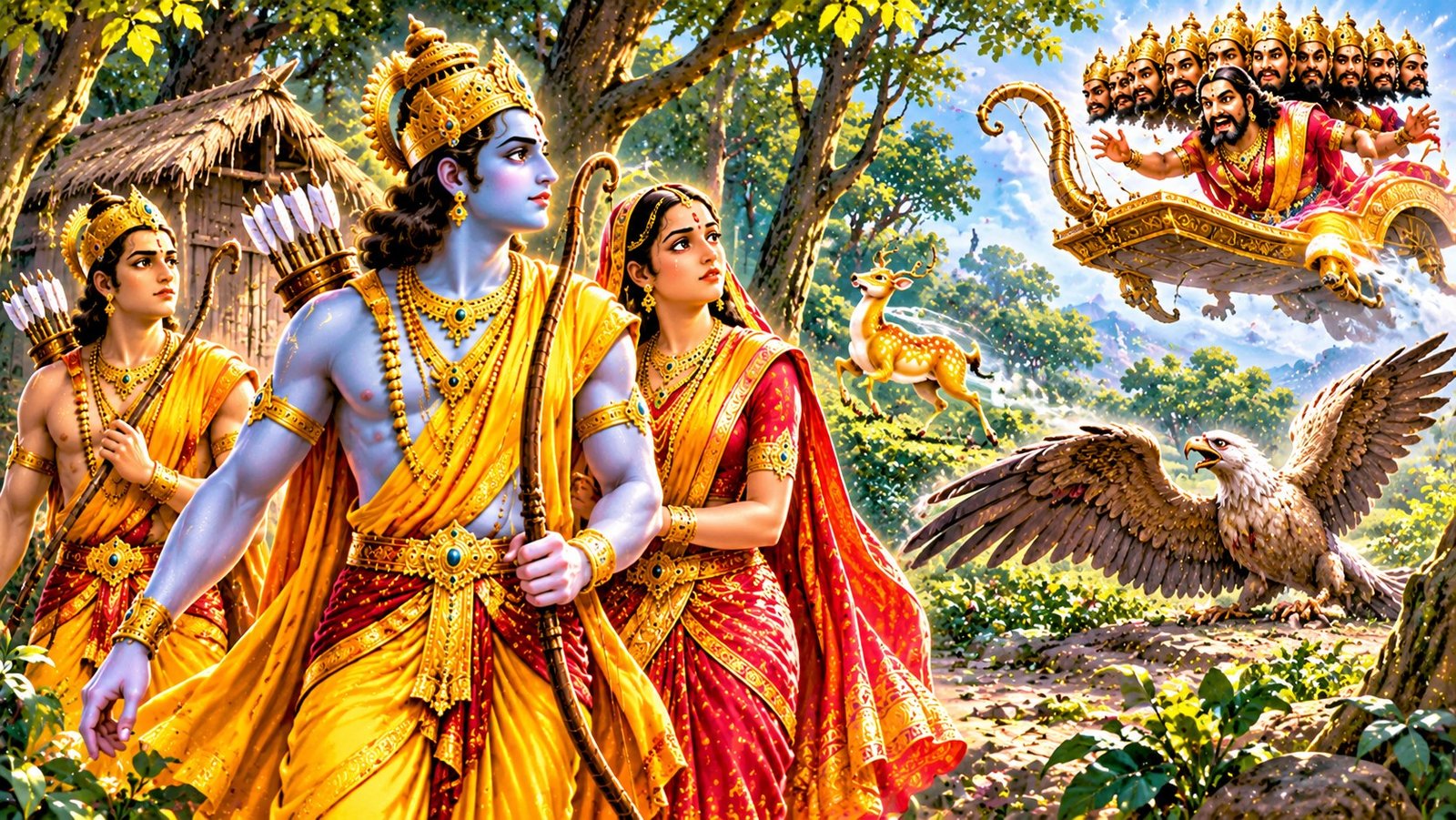
Explore the third book of the Valmiki Ramayana: Rama, Sita and Lakshmana in Dandakaranya, the sages and hermitages of the forest, Panchavati, Shurpanakha, the golden deer, Ravana's abduction of Sita, Jatayu's sacrifice, and the meeting with Kabandha and Shabari.
Introduction: The Book of the Forest
Aranya Kanda, the third book of the Valmiki Ramayana, follows Rama, Sita and Lakshmana after their departure from Ayodhya. The word aranya means forest, and this Kanda takes the exiled family into the vast wilderness of Dandakaranya, where they encounter sages, hermitages, forest beings and tests of character.
The forest is not merely a setting for adventure. It is a place where questions of duty, protection, restraint, desire and compassion become urgent. The Kanda moves from the peaceful world of the hermitages to the crisis at Panchavati, where Ravana abducts Sita. It then follows Rama's grief and his first steps in the search that will lead to an alliance with Sugriva in the next Kanda.
Entering Dandakaranya and Meeting the Sages
Rama, Sita and Lakshmana enter Dandakaranya and visit the hermitages of ascetics who have made the forest their home. The sages welcome Rama and describe the dangers they face from hostile rakshasas who disturb their rites and threaten their lives. They ask him for protection.
During their journey, the brothers encounter Viradha, a formidable forest being who seizes Sita. Rama and Lakshmana fight him, overcome him and release him from the condition that has bound him. The encounter introduces the dangers of the wilderness and the responsibility Rama accepts toward those who seek refuge and protection.
The travellers meet revered ascetics, including Sharabhanga and Sutikshna. Their hermitages represent a world of discipline and spiritual practice, but the sages' accounts also make clear that peaceful life in the forest is under threat.
Sita's Question: Protection, Duty and Restraint
One of the important conversations in Aranya Kanda takes place when Sita speaks to Rama about his commitment to oppose the rakshasas. She does not dismiss his concern for the sages, but she asks him to consider the danger of carrying weapons and allowing anger to turn into unnecessary violence against those who have done no harm.
Rama explains that he has given his word to protect the ascetics who have asked for help. He believes that keeping this promise is part of his duty. The exchange is significant because it presents a thoughtful discussion about the limits of force, the responsibility of a protector and the need to act with discernment rather than anger.
The Hermitage of Agastya and the Gift of Divine Weapons
Rama and Lakshmana continue through the forest and eventually reach the hermitage of the great sage Agastya. The sage receives them with honour and speaks about the duties and challenges that lie ahead. Agastya gives Rama divine weapons, including a bow, arrows and a sword, according to the Valmiki narrative.
Agastya advises Rama to settle at Panchavati, a beautiful region associated with the Godavari. The place offers a suitable setting for the next phase of their forest life. As they travel there, they meet Jatayu, the noble vulture and a friend of Dasharatha. Jatayu tells Rama of his connection with the royal family and offers to protect Sita whenever the brothers are away.
Life at Panchavati
At Panchavati, Lakshmana prepares a dwelling for Rama and Sita. The three live in the forest, surrounded by trees, rivers and the changing seasons. The setting initially appears peaceful, and Jatayu remains nearby as a well-wisher and guardian.
The description of the forest and its seasons gives the reader a sense of the life the exiles have built. Yet the peace of Panchavati is fragile. The arrival of Shurpanakha brings a sequence of confrontations that will eventually draw Ravana into the story.
Shurpanakha and the Conflict at Janasthana
Shurpanakha encounters Rama and becomes attracted to him. Rama declines her advances and directs her toward Lakshmana, who also refuses her. The encounter escalates when Shurpanakha turns against Sita. Lakshmana intervenes and disfigures her.
Shurpanakha goes to her relatives in Janasthana and appeals for revenge. Khara, Dushana and other rakshasas send forces against Rama. Rama faces the attackers and defeats them. Khara then leads a much larger force into battle, but Rama overcomes Khara, Dushana and the warriors who accompany them.
The destruction of the Janasthana forces is a decisive event. Shurpanakha carries the news to Ravana, presenting the conflict in a way that awakens his desire for revenge and his interest in Sita. The forest conflict now reaches the court of Lanka.
Ravana Seeks Maricha's Help
Ravana consults Maricha and reveals his intention to take Sita. Maricha understands the danger of opposing Rama and warns Ravana against the plan. He recalls Rama's extraordinary strength and urges Ravana to abandon the scheme.
Ravana refuses to listen. He insists that Maricha help him carry out the deception. Maricha recognises that either choice may lead to death, but he eventually agrees to take the form of an extraordinary golden deer in order to draw Rama away from the hermitage.
The Golden Deer and Sita's Abduction
The golden deer appears near the hermitage, captivating Sita with its unusual beauty. She asks Rama to capture it, and Rama follows it into the forest. Before leaving, Rama asks Lakshmana to remain with Sita and keep her safe.
The deer leads Rama far from the dwelling. When Rama finally strikes it, Maricha resumes his own form and cries out in a voice imitating Rama, calling for Lakshmana and Sita. Hearing the cry, Sita becomes distressed and urges Lakshmana to go to Rama's aid. Lakshmana is reluctant to leave her, but eventually goes.
Ravana approaches the now unguarded hermitage in the disguise of an ascetic. He speaks with Sita and then reveals his identity and intention. When she refuses him, Ravana seizes her and carries her away in his aerial chariot. Sita calls out to Rama and Lakshmana and appeals to the forest, rivers, trees and creatures to bear witness to what is happening.
Jatayu's Courageous Battle
Jatayu hears Sita's cries and confronts Ravana in an attempt to rescue her. Though aged, the noble bird fights with extraordinary courage. He challenges Ravana's conduct and tries to stop the chariot, striking at the rakshasa and damaging his equipment.
Ravana eventually overpowers Jatayu and cuts his wings. The wounded bird falls to the earth while Ravana continues toward Lanka with Sita. Jatayu's action is one of the most moving moments in the Kanda: he risks his life to protect someone who has been entrusted to his care.
The popular image of Jatayu as a symbol of selfless courage grows from this episode. His loyalty is not based on power or expectation of reward; he acts because Sita is in danger and because he honours his friendship with Dasharatha.
Rama's Grief and the Discovery of Jatayu
Rama and Lakshmana return to the hermitage and discover that Sita is missing. Rama searches the surroundings in anguish, asking trees, animals and the natural world whether they have seen her. His grief is intense, and the forest that once offered shelter now seems filled with reminders of separation.
The brothers find the wounded Jatayu. Before dying, Jatayu tells Rama that Ravana carried Sita away toward the south. He explains that he fought to stop the abduction but was defeated. Rama honours the bird and performs the funeral rites for him with the respect due to a beloved elder and friend.
Jatayu's final message gives Rama a direction for the search. His sacrifice also reveals that courage and loyalty can arise from unexpected places, and that the duty to protect another can demand the highest personal cost.
Kabandha and the Path Toward Sugriva
As Rama and Lakshmana continue their search, they encounter Kabandha, a fearsome being with an unusual form and long arms. The brothers fight him and release him from the condition that has made him a terror in the forest. Once freed, Kabandha reveals his former identity and offers guidance.
Kabandha advises Rama to seek the friendship of Sugriva, who lives near Lake Pampa and the Rishyamuka region. Sugriva, he explains, has been separated from his kingdom and may become an ally. This advice points the story toward Kishkindha Kanda, where Rama and Hanuman will meet and the search for Sita will take a new direction.
Shabari's Devotion
Rama and Lakshmana reach the hermitage associated with Shabari, a devoted ascetic who has waited for Rama's arrival in accordance with the guidance of her teachers. She welcomes the brothers with reverence and offers the hospitality of her hermitage.
Shabari speaks of the sages who once lived there and of the spiritual discipline they practised. After receiving Rama, she completes her life's purpose and attains the fulfilment described in the text. Her episode honours devotion, service and spiritual aspiration.
A familiar later devotional telling says that Shabari tasted each berry before offering it to Rama to ensure its sweetness. This beloved detail is not narrated in the same way in the Valmiki Ramayana. The Valmiki account presents Shabari's devotion through her waiting, hospitality and spiritual dedication, without that tasting episode.
Key Characters in Aranya Kanda
Rama remains committed to protecting the sages and searching for Sita, even as grief tests his composure. Sita is shown as devoted and courageous, and her conversation with Rama about the use of force adds an important ethical dimension to the story. Lakshmana serves as Rama's steadfast companion and protector.
Among the sages are Sharabhanga, Sutikshna and Agastya. Jatayu becomes a symbol of selfless courage. Shurpanakha's encounter at Panchavati sets the conflict in motion; Khara and Dushana represent the forces Rama confronts at Janasthana; Maricha enables Ravana's deception; and Kabandha and Shabari help guide Rama toward the next stage of his journey.
Teachings and Reflections
Protection with discernment: Sita's conversation with Rama reminds readers that the duty to protect must be guided by judgment and restraint, not by uncontrolled anger.
The danger of unchecked desire: The events at Panchavati show how desire, pride and revenge can set destructive events in motion.
Courage beyond strength: Jatayu is physically outmatched by Ravana, yet he acts with extraordinary bravery because another life is at stake.
Devotion expressed through service: Shabari's long preparation and respectful welcome show devotion through patience, hospitality and spiritual discipline.
Guidance in difficult times: The counsel of sages and the directions given by Kabandha help Rama move forward when the path seems uncertain.
Aranya Kanda in the Wider Ramayana
Aranya Kanda forms the bridge between the exile in Ayodhya Kanda and the alliance of Kishkindha Kanda. The peaceful forest life of the exiles is broken by Sita's abduction, and Rama's search begins. Jatayu's final message, Kabandha's counsel and Shabari's welcome all point toward the region of Pampa and the meeting with Sugriva.
This article follows the narrative of the Valmiki Ramayana. Later devotional, regional and performance traditions often add memorable details or interpret episodes in distinctive ways. The familiar Lakshmana Rekha episode, for example, is not narrated in the Valmiki Aranya Kanda in the popular form known from later retellings. Such traditions remain culturally important, but they should be distinguished from the Sanskrit epic's own account.
Conclusion: Courage and Devotion in the Forest
Aranya Kanda is a story of protection, temptation, loss and the strength to continue. The forest tests Rama and Lakshmana, reveals Sita's moral insight, and brings forward figures whose courage and devotion leave a lasting impression. Jatayu's sacrifice and Shabari's welcome show that greatness is not measured only by power or position.
The Kanda ends with Rama moving toward Pampa, carrying grief but also receiving guidance for the road ahead. The search for Sita will soon become a shared mission, and the next chapter of the Ramayana will begin with the friendship between Rama and Sugriva.