
Sacred scriptures
Yajurveda: Exploring the Sacred Wisdom of Vedic Rituals
Explore the Yajurveda, its sacred mantras and ritual traditions, the Shukla and Krishna recensions, and its enduring place in Sanatan Dharma.
1. Introduction to the Yajurveda
The Yajurveda is one of the four Vedas, the foundational bodies of sacred knowledge in Sanatan Dharma. Its name is associated with yajus, or ritual formulas, and its central emphasis is on the mantras and instructions used in Vedic ceremonies.
While the Rigveda is especially known for its hymns and the Samaveda for its melodic chanting, the Yajurveda is closely connected with the practical performance of yajna. It brings together sacred words, ritual actions, and disciplined attention in the worship of the divine.
2. The Meaning and Purpose of Yajna
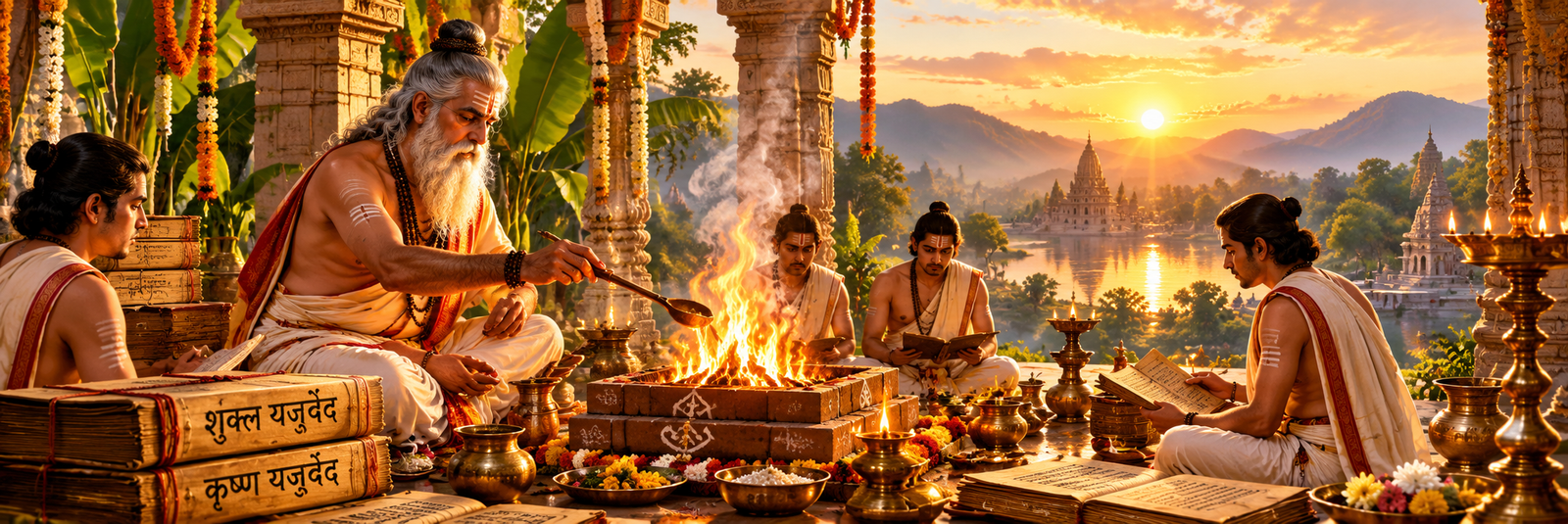
Yajna is a Vedic ritual offering performed according to established traditions. In many ceremonies, offerings such as ghee and other prescribed materials are placed into a sacred fire while mantras are recited. The exact procedure varies according to the ritual and its Vedic tradition.
Yajna has also inspired wider reflections on gratitude, duty, generosity, and the interconnectedness of life. Its significance is understood through the particular text, ritual, and philosophical tradition being studied.
3. Shukla Yajurveda and Krishna Yajurveda
The Yajurveda is preserved in two major traditions commonly known as Shukla Yajurveda, or White Yajurveda, and Krishna Yajurveda, or Black Yajurveda. These names distinguish two different arrangements and textual traditions, rather than two separate Vedas.
The Shukla Yajurveda generally presents its mantra collections separately from their explanatory ritual prose. The Krishna Yajurveda combines mantras and explanatory material more closely within its textual arrangement.
Important surviving traditions include the Madhyandina and Kanva recensions of the Shukla Yajurveda, and the Taittiriya, Maitrayani, Kathaka, and Kapishthala-Katha traditions associated with the Krishna Yajurveda.
4. The Role of the Adhvaryu Priest
In the traditional Vedic ritual system, the Adhvaryu priest is responsible for many of the practical actions of a ceremony. This includes preparing the ritual space, arranging offerings, carrying out prescribed actions, and reciting the appropriate Yajurvedic formulas.
Vedic ceremonies could involve several specialist priests, each with distinct responsibilities. Their coordinated work reflects the careful organisation of ritual practice and the importance of accurate recitation and procedure.
5. Mantras, Offerings, and Sacred Discipline
Yajurvedic mantras accompany particular actions within Vedic rituals. Their words, pronunciation, sequence, and ritual context are significant within the traditions that preserve them. The mantras are therefore studied alongside the procedures and explanations with which they are associated.
The wider lessons readers may draw from this tradition include attentiveness, preparation, responsibility, and reverence. These reflections should complement, rather than replace, an accurate understanding of the historical and ritual context.
6. The Yajurveda and the Upanishads
Some important Upanishads are associated with Yajurvedic traditions. The Isha Upanishad is transmitted with the Shukla Yajurveda, while the Taittiriya Upanishad belongs to the Taittiriya tradition of the Krishna Yajurveda.
These philosophical texts explore questions concerning the Self, knowledge, action, renunciation, and ultimate reality. Their presence within Yajurvedic traditions illustrates the breadth of Vedic literature, which includes ritual instruction as well as profound philosophical inquiry.
7. The Yajurveda in Vedic Literature
The four Vedas have distinct yet interconnected roles. The Rigveda preserves collections of hymns, the Samaveda arranges verses for specialised melodic chanting, the Yajurveda provides formulas and material associated with ritual performance, and the Atharvaveda contains hymns and compositions addressing a wide range of concerns.
Studying the Vedas together helps readers understand their shared vocabulary, related traditions, and different literary and ritual purposes. No single description captures every feature of these extensive collections.
8. Relevance for the Modern Reader
For modern readers, the Yajurveda offers an opportunity to explore the history of Vedic ritual, Sanskrit recitation, religious practice, and the development of Indian philosophical traditions. It can also encourage reflection on the value of careful action, responsibility, and gratitude.
Historical study and spiritual reflection benefit from reliable translations, attention to context, and respect for the living traditions through which Vedic texts have been preserved.
9. A Simple Guide to Studying the Yajurveda
Begin with an introduction to the four Vedas and learn the difference between the Shukla and Krishna Yajurveda. Next, explore a reputable translation or scholarly introduction to a selected passage, noting its ritual setting and any accompanying explanation.
When studying Sanskrit mantras, use a reliable text or recording from a knowledgeable tradition for pronunciation and interpretation. Read related Upanishadic material separately, and distinguish the original text from later commentary and modern interpretation.
10. Shukla Yajurveda and Krishna Yajurveda: Key Differences
The Yajurveda is preserved in two major traditions known as Shukla Yajurveda and Krishna Yajurveda. Both preserve ritual mantras and knowledge associated with Vedic sacrifice, but they differ in the arrangement of their textual material.
The Shukla Yajurveda is commonly associated with a clearer separation between its Samhita of mantras and its explanatory Brahmana literature. The Krishna Yajurveda combines mantra material with explanatory prose in its textual tradition. These distinctions help readers understand why different Yajurvedic recensions have their own structures and study methods.
The Shukla Yajurveda includes the Madhyandina and Kanva Samhitas. Important Krishna Yajurveda Samhitas include the Taittiriya, Maitrayani, Kathaka, and Kapishthala-Katha traditions. These names represent distinct textual lineages, not different names for one identical edition.
Studying both traditions provides a richer understanding of the preservation and transmission of Vedic knowledge. Readers should consult editions that clearly identify the recension and translation being used.
11. The Adhvaryu Priest and the Practical Role of Yajurvedic Mantras
The Yajurveda is closely associated with the Adhvaryu priest, whose responsibilities in Vedic ritual include practical arrangements and the performance of prescribed actions. Yajurvedic mantras accompany particular stages of ritual activity and help connect spoken formulas with ceremonial procedures.
In a traditional Vedic sacrifice, ritual responsibilities are distributed among different priestly roles. The Adhvaryu's work therefore forms part of a coordinated system rather than an isolated performance. The Yajurveda preserves mantras and ritual instructions that illuminate this relationship between recitation and action.
The meaning of a ritual formula depends on its textual setting, pronunciation, and prescribed use. Readers exploring these traditions should distinguish the explanations found in traditional ritual literature from modern historical interpretations.
For students of Sanatan Dharma, this ritual context explains why the Yajurveda is especially valuable for understanding the organisation, language, and performance of Vedic yajna.
12. Important Upanishads Associated with the Yajurveda
The Yajurvedic tradition is connected with several important Upanishads, which explore questions of the Self, ultimate reality, knowledge, and the meaning of existence. These texts show that the broader Yajurvedic heritage includes philosophical inquiry as well as ritual material.
The Isha or Ishavasya Upanishad is associated with the Shukla Yajurveda and forms the concluding fortieth chapter of the Vajasaneyi Samhita. Its brief verses reflect on the relationship between the world, action, renunciation, and spiritual understanding.
The Brihadaranyaka Upanishad is another major text associated with the Shukla Yajurveda. It contains extensive philosophical discussions, including inquiries into the Self and ultimate reality. The Taittiriya and Katha Upanishads are among the important Upanishads associated with the Krishna Yajurveda.
Readers should study these works in reliable translations and pay attention to their individual contexts. Although these Upanishads belong to the wider Yajurvedic heritage, each has its own structure, teaching style, and philosophical emphasis.
13. Frequently Asked Questions About the Yajurveda
What is the main focus of the Yajurveda? The Yajurveda is especially associated with the mantras, formulas, and ritual procedures used in Vedic sacrifice. It also contributes to the wider understanding of Vedic religious and philosophical traditions.
What is the difference between Shukla and Krishna Yajurveda? Their textual arrangements differ. The Shukla tradition generally separates the Samhita's mantras from explanatory Brahmana material, while the Krishna tradition combines mantra and explanatory material within its textual tradition.
Who is the Adhvaryu priest? The Adhvaryu is the priest traditionally responsible for many practical and procedural aspects of a Vedic sacrifice, using Yajurvedic formulas as prescribed by the ritual tradition.
Which Upanishads are associated with the Yajurveda? Important examples include the Isha and Brihadaranyaka Upanishads of the Shukla Yajurveda, and the Taittiriya and Katha Upanishads associated with the Krishna Yajurveda.
How should beginners study the Yajurveda? Begin with a reliable introduction, learn the distinction between its major traditions, and use a trustworthy translation that identifies its source text and recension. For deeper study, consult the relevant Samhita and associated explanatory literature.
14. Conclusion
The Yajurveda is an essential part of the Vedic heritage of Sanatan Dharma. Its ritual formulas, textual traditions, and relationship with other Vedic literature offer a rich field of study for anyone seeking to understand the foundations of Vedic practice.
Studied alongside the Rigveda, Samaveda, and Atharvaveda, it reveals the diversity and interconnectedness of the four Vedas and invites continued exploration of their spiritual, cultural, and intellectual legacy.