
KRISHNA LEELA · STORIES & WISDOM
Stories from the Krishna tradition
Krishna Leela: Divine Stories of Shri Krishna
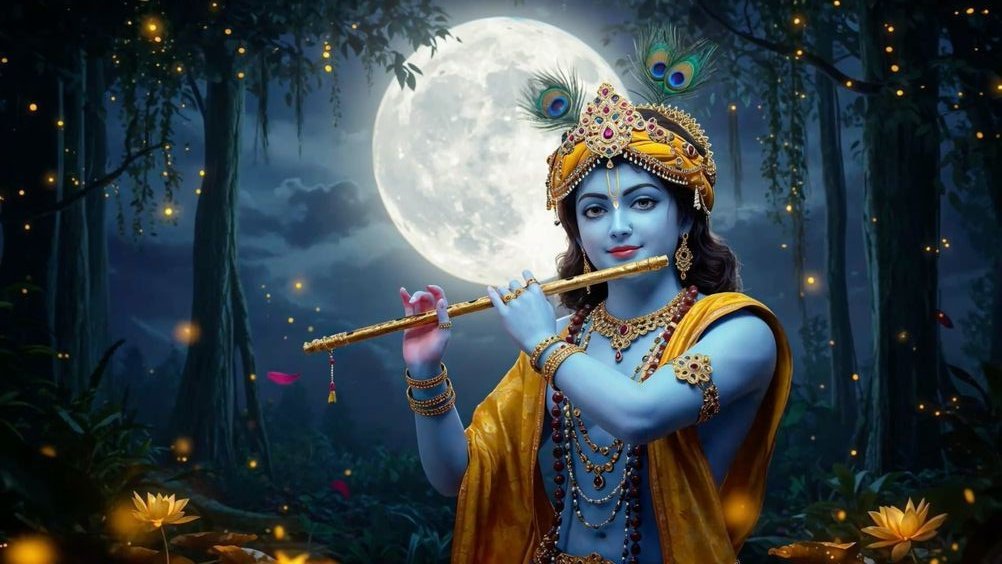
Explore stories of Krishna's birth, childhood pastimes, the defeat of Kansa, his friendship and teachings, and the Dashavatara tradition. Each account includes a short reflection and acknowledges that details can differ across scriptures and regional retellings.
EXPLORE THE STORIES
12 Stories of Krishna Leela
Select a story to read its traditional narrative and the reflection it offers.
The Divine Birth of Shri Krishna
The birth of Krishna in Mathura, the prophecy that frightened Kansa, and Vasudeva's journey across the Yamuna.
Read full storyKrishna and Putana
The infant Krishna encounters the demoness Putana, sent by Kansa to harm him.
Read storyMakhan Chor: Krishna and the Butter Pots
The playful child Krishna sneaks butter with his friends, delighting and exasperating the people of Vraja.
Read storyKrishna Dances on Kaliya the Serpent
Krishna confronts the poisonous serpent Kaliya in the Yamuna and dances upon its hoods.
Read storyKrishna Lifts Govardhan Hill
Krishna shelters the people and cattle of Vraja beneath Govardhan Hill during a devastating storm.
Read storyKrishna Defeats His Uncle Kansa
Krishna returns to Mathura, overcomes Kansa's champions and ends the tyrant's rule.
Read storyKrishna and Rukmini
Rukmini sends Krishna a message asking him to rescue her from a marriage she does not wish to enter.
Read storyKrishna and Sudama: The Gift of Friendship
Sudama visits his childhood friend Krishna with a humble offering of flattened rice.
Read storyKrishna's Teachings to Arjuna in the Bhagavad Gita
On the battlefield of Kurukshetra, Krishna guides Arjuna through a crisis of duty, grief and moral uncertainty.
Read storyKrishna Reveals the Universal Form
Krishna grants Arjuna a vision of the vast cosmic form described in the Bhagavad Gita.
Read storyDashavatara: The Ten Avatars of Vishnu
Explore the traditional list of ten celebrated manifestations of Vishnu, with Krishna included in many lists.
Read storyKrishna Leaves Vraja and Goes to Dvaraka
Krishna's life moves from the pastoral world of Vraja to Mathura and later Dvaraka, where he takes on new responsibilities.
Read story1. The Divine Birth of Shri Krishna
The birth of Krishna in Mathura, the prophecy that frightened Kansa, and Vasudeva's journey across the Yamuna.
In the traditional account, Mathura was ruled by Kansa, whose sister Devaki married Vasudeva. A divine voice or prophecy warned Kansa that Devaki's eighth child would bring about his end. Terrified, Kansa imprisoned the couple and kept watch over their children. The story portrays fear turning a ruler toward cruelty: instead of changing his conduct, Kansa tried to defeat the prophecy through violence.
When Krishna was born, the prison guards were overcome by sleep and the doors opened in the miraculous telling. Vasudeva carried the infant across the Yamuna during a storm to Gokul, where he exchanged Krishna with the newborn daughter of Yashoda and Nanda. Protected by divine grace in the devotional narrative, Krishna grew up away from Kansa's immediate reach. Details differ across texts and regional retellings, but the birth story is celebrated as the arrival of hope and divine protection.
Reflection
Courage and faith can help people face danger without surrendering hope.
2. Krishna and Putana
The infant Krishna encounters the demoness Putana, sent by Kansa to harm him.
Kansa sent dangerous beings to search for the child he feared. Among them was Putana, who came to Gokul disguised as a beautiful woman and offered to nurse the infant Krishna. In the Bhagavata Purana account, her intention was deadly, but Krishna was unharmed and Putana was defeated.
Many devotional tellings add a striking note of compassion: because Putana had approached Krishna in the role of a nurse, she received a spiritual benefit despite her hostile intent. Interpretations vary, but the episode often invites reflection on the power of the divine and the transformation of even a harmful encounter within devotional theology.
Reflection
The episode is often read as a triumph of divine protection over concealed harm.
3. Makhan Chor: Krishna and the Butter Pots
The playful child Krishna sneaks butter with his friends, delighting and exasperating the people of Vraja.
Stories of young Krishna stealing butter are among the most beloved scenes of Vraja. Krishna and his friends find ways to reach pots kept high above the ground, sometimes forming human pyramids. When the gopis complain to Yashoda, their frustration is often mixed with affection for the mischievous child.
In bhakti poetry and painting, butter can symbolize the loving essence hidden within the heart, which Krishna draws out through intimacy and play. The stories are not simply about mischief; they portray a relationship with the divine filled with laughter, affection and familiarity.
4. Krishna Dances on Kaliya the Serpent
Krishna confronts the poisonous serpent Kaliya in the Yamuna and dances upon its hoods.
In the traditional story, the waters of part of the Yamuna become dangerous because the serpent Kaliya has made his home there. Krishna leaps into the river and confronts the serpent. After a fierce struggle, Krishna dances upon Kaliya's many hoods, displaying divine power while the serpent's family pleads for mercy.
Krishna eventually spares Kaliya and directs him to leave the river for another place. The episode is often understood as the restoration of balance and the protection of the community. It also gives artists one of the most recognizable images of Krishna: the youthful Lord dancing gracefully upon the serpent.
Reflection
Courage should be joined with restraint; victory need not mean needless cruelty.
5. Krishna Lifts Govardhan Hill
Krishna shelters the people and cattle of Vraja beneath Govardhan Hill during a devastating storm.
When the people of Vraja prepare their customary offerings to Indra, Krishna encourages them to honour Govardhan Hill, the land, cattle and natural world that sustain their lives. Indra becomes angry in the traditional narrative and sends torrential rain. Krishna lifts Govardhan Hill with one finger, providing shelter for the people and animals for seven days.
Indra eventually recognizes Krishna's greatness and his own pride. The story is associated with Govardhan Puja and is interpreted as a lesson in humility, care for nature, community solidarity and divine protection. Practices and explanations vary among regional traditions.
Reflection
True leadership protects the community, and humility is greater than pride.
6. Krishna Defeats His Uncle Kansa
Krishna returns to Mathura, overcomes Kansa's champions and ends the tyrant's rule.
As Krishna grows up, Kansa continues to fear the prophecy concerning Devaki's child. He arranges a wrestling festival in Mathura and attempts to have Krishna and Balarama killed. The brothers face the royal wrestlers, and Krishna ultimately confronts Kansa in the arena.
In the Bhagavata Purana and many popular retellings, Krishna pulls Kansa down from his throne and kills him, ending his oppressive reign. Krishna then frees Devaki and Vasudeva and restores dignity to the family. This episode is remembered as the defeat of tyranny, though traditions vary in the details and emphasis of the account.
Reflection
Power without justice becomes tyranny; courage must stand against oppression.
7. Krishna and Rukmini
Rukmini sends Krishna a message asking him to rescue her from a marriage she does not wish to enter.
Rukmini, a princess of Vidarbha, wishes to marry Krishna, but her family plans to give her in marriage to Shishupala. In a celebrated account, she sends Krishna a message describing her situation and asking him to come before the wedding. Krishna travels to Vidarbha and takes her away, with Balarama and others involved in the events that follow.
The story is told in different forms across Puranic and regional traditions. Devotees often remember it as a tale of Rukmini's steadfast devotion and Krishna's response to her plea. It also belongs to the larger cycle of stories about Krishna's life as a prince and ruler.
Reflection
The story highlights devotion, personal resolve and the importance of listening to a sincere appeal.
8. Krishna and Sudama: The Gift of Friendship
Sudama visits his childhood friend Krishna with a humble offering of flattened rice.
Sudama, also known as Kuchela in some traditions, lives in poverty but remembers his childhood friendship with Krishna. Encouraged by his wife, he travels to Dvaraka carrying a small bundle of flattened rice as a gift. He feels shy about offering something so modest to a king.
Krishna welcomes Sudama warmly, seats him with honour and accepts the humble gift with delight. Sudama leaves without asking for riches, yet finds that his circumstances have changed by the time he returns home. The story is cherished as a portrait of friendship without pride and generosity that recognizes the heart behind an offering.
9. Krishna's Teachings to Arjuna in the Bhagavad Gita
On the battlefield of Kurukshetra, Krishna guides Arjuna through a crisis of duty, grief and moral uncertainty.
As the armies gather at Kurukshetra, Arjuna sees relatives, teachers and friends among those he must fight. Overwhelmed, he lowers his bow and questions whether battle can be right. Krishna, serving as his charioteer, responds with a teaching that explores the self, duty, disciplined action, knowledge, meditation and devotion.
The Bhagavad Gita presents several paths of spiritual practice and emphasizes acting without selfish attachment to the fruits of action. Krishna's teaching is profound and has been interpreted in many philosophical traditions; readers should engage with the text and its commentaries rather than reduce it to a single slogan. Its central dialogue remains a guide to reflection during difficult choices.
Reflection
Act thoughtfully, fulfil your responsibilities and do not let attachment alone govern your choices.
10. Krishna Reveals the Universal Form
Krishna grants Arjuna a vision of the vast cosmic form described in the Bhagavad Gita.
In the Bhagavad Gita's eleventh chapter, Arjuna asks to see Krishna's universal form. Krishna grants him divine sight, and Arjuna beholds a form containing countless faces, eyes and wonders, with the whole universe gathered within it. The vision inspires awe and fear as Arjuna sees creation, time and the destiny of the warriors in a scale beyond ordinary experience.
Arjuna praises Krishna and asks forgiveness for having treated him only as a friend in familiar moments. The episode shifts the dialogue from intimate friendship to cosmic revelation. It is a reminder in the text that the familiar presence of Krishna and the immeasurable reality he reveals are not mutually exclusive.
Reflection
The divine exceeds ordinary perception, and human understanding has limits.
11. Dashavatara: The Ten Avatars of Vishnu
Explore the traditional list of ten celebrated manifestations of Vishnu, with Krishna included in many lists.
Dashavatara means the ten avatars of Vishnu. A widely known list includes Matsya (the fish), Kurma (the tortoise), Varaha (the boar), Narasimha (the man-lion), Vamana (the dwarf), Parashurama, Rama, Krishna, Buddha and Kalki. Some Vaishnava traditions list Balarama instead of Buddha, and regional sources may arrange or explain the list differently.
The stories associated with the avatars describe divine intervention at times when dharma is threatened. Matsya saves life through a great flood; Kurma supports the churning of the ocean; Varaha rescues the Earth; Narasimha protects Prahlada; Vamana humbles Bali; Parashurama and Rama are linked with the restoration of order; Krishna teaches and protects; Buddha appears in certain lists with a particular theological interpretation; and Kalki is generally described as a future avatar. These are sacred narratives with varied textual and theological traditions, not one uniform account.
Reflection
The avatar stories express the restoration of dharma and the protection of life and cosmic order.
12. Krishna Leaves Vraja and Goes to Dvaraka
Krishna's life moves from the pastoral world of Vraja to Mathura and later Dvaraka, where he takes on new responsibilities.
Krishna's childhood and youth in Vraja are remembered through stories of family affection, friendship, the gopis, the cows and the music of his flute. After Kansa's defeat, Krishna's life takes a different direction. He remains involved in the protection of his family and people, and later traditions describe his role in Dvaraka as a ruler, relative, friend and statesman.
The movement from Vraja to Dvaraka is treated differently across devotional traditions. For many bhakti communities, the longing of the people of Vraja becomes a powerful expression of love in separation. The stories invite reflection on how affection can endure even when life changes and duties call a person elsewhere.
Reflection
Love, remembrance and responsibility can coexist through change and separation.
Continue exploring Shri Krishna
Enjoyed these stories? Explore Krishna's sacred names, mantras, stotras and prayers, with a growing devotional library of meanings and traditional context.