
KRISHNA LEELA · STORY 01
A sacred story from the Krishna tradition
The Divine Birth of Shri Krishna
The story of Devaki and Vasudeva, the fearful king Kansa, and the extraordinary journey that carried the newborn Krishna from Mathura to Gokul.
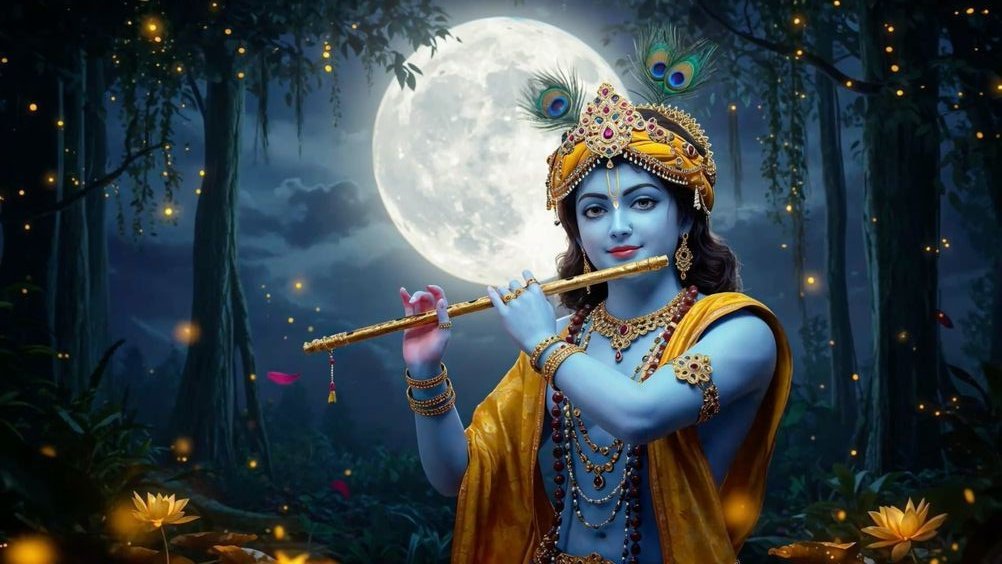
A prophecy that filled a king with fear
Long ago, Mathura was ruled by Kansa, a powerful king remembered in Hindu sacred narratives for his cruelty and fear. His sister Devaki married the noble Vasudeva. According to the traditional account, as Kansa was escorting the newly married couple, a heavenly voice—or, in some retellings, a divine prophecy—announced that Devaki's eighth child would bring about Kansa's death.
The warning transformed Kansa's happiness into terror. Rather than question his conduct or rule with greater justice, he decided to destroy the very children he feared. Vasudeva pleaded with him and promised to hand over their children, hoping to save Devaki's life. Kansa imprisoned the couple and kept them under guard. Their endurance contrasts with Kansa's growing cruelty.
Different scriptures and regional tellings describe details of the prophecy, the imprisonment and the earlier children in different ways. The central theme remains clear: fear, when ruled by selfishness, can lead a person to commit terrible acts in the name of self-preservation.
The birth of the eighth child
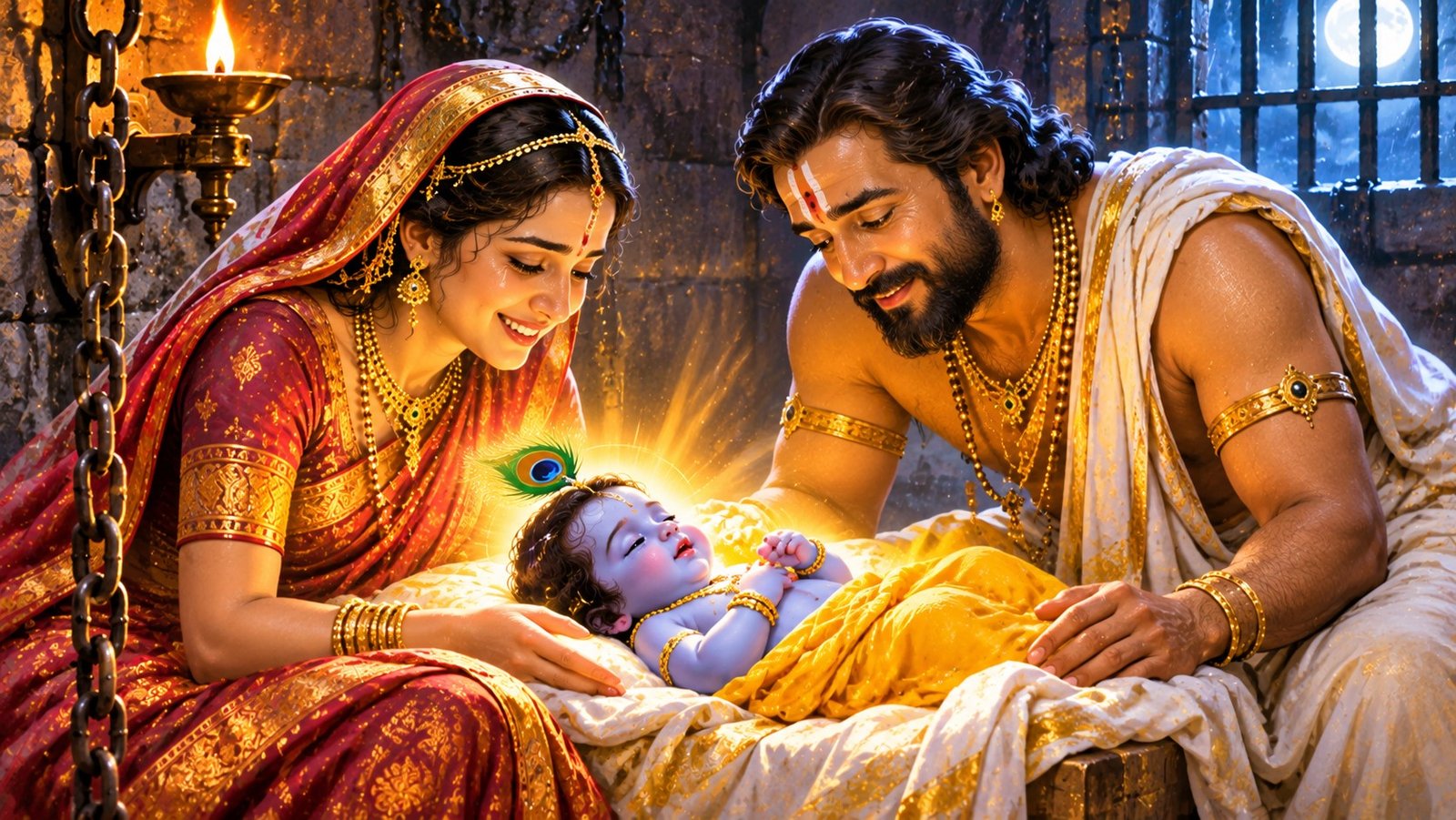
As the years passed, Devaki and Vasudeva remained imprisoned. The traditional story tells that when the time came for their eighth child to be born, the prison was filled with divine wonder. Krishna appeared at midnight, a moment remembered by devotees during Janmashtami, the festival celebrating his birth. In many devotional accounts, the infant first reveals a divine form to his parents and then appears as a child they can lovingly hold.
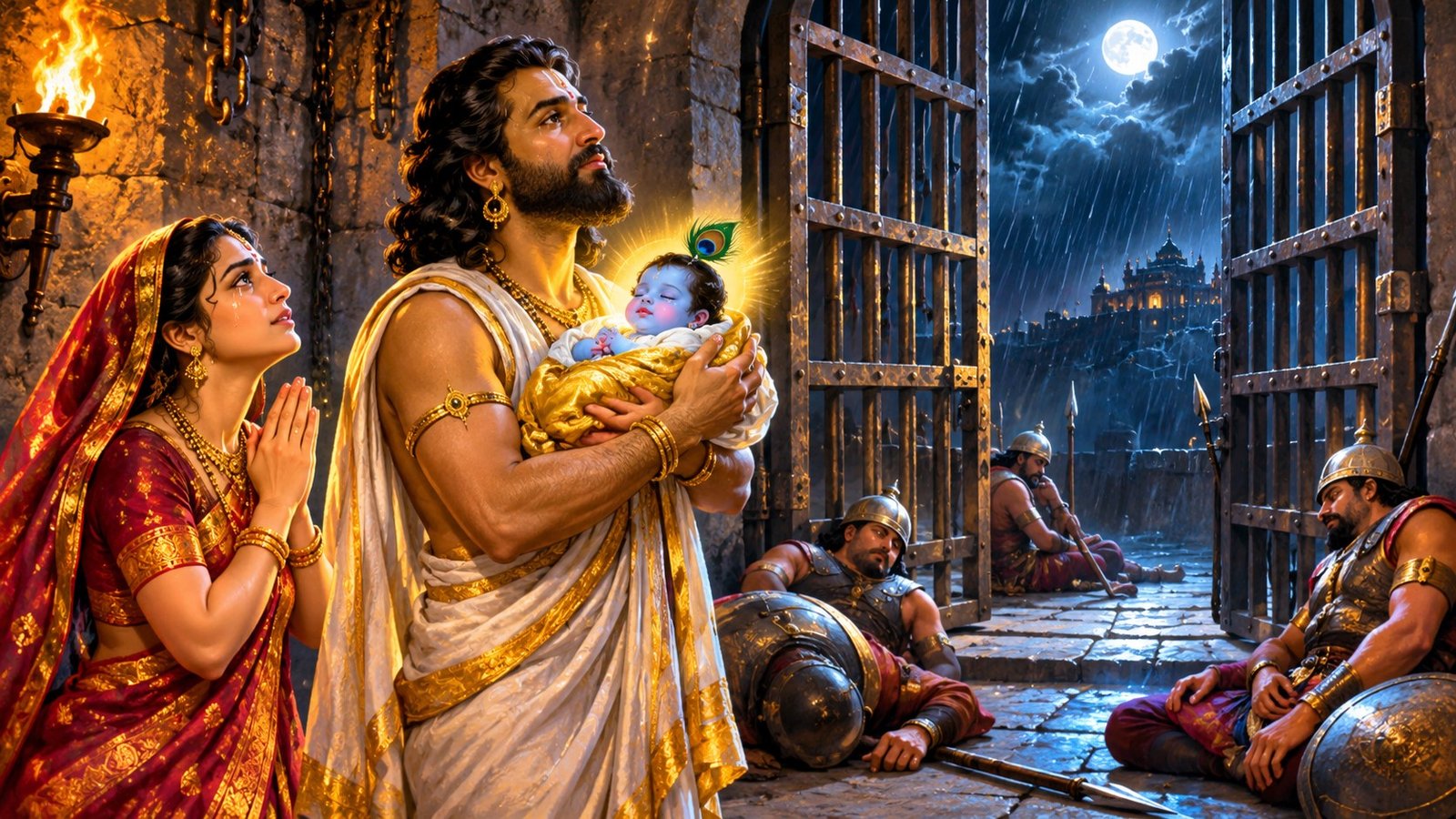
Devaki and Vasudeva understood that the child was no ordinary infant. Yet their joy was accompanied by danger: Kansa's guards were nearby, and the king would not allow the prophecy to be forgotten. In the miraculous telling, the guards fell into a deep sleep, the prison doors opened, and the chains that bound Vasudeva loosened. These events are narrated as signs that divine purpose could not be contained by the king's walls or weapons.
Vasudeva now faced a difficult task. He had to carry the newborn away from Mathura and place him somewhere safe, even though the night was dark and the countryside was threatened by a storm. His courage was not the absence of fear; it was his willingness to act carefully for the child's protection despite the danger around him.
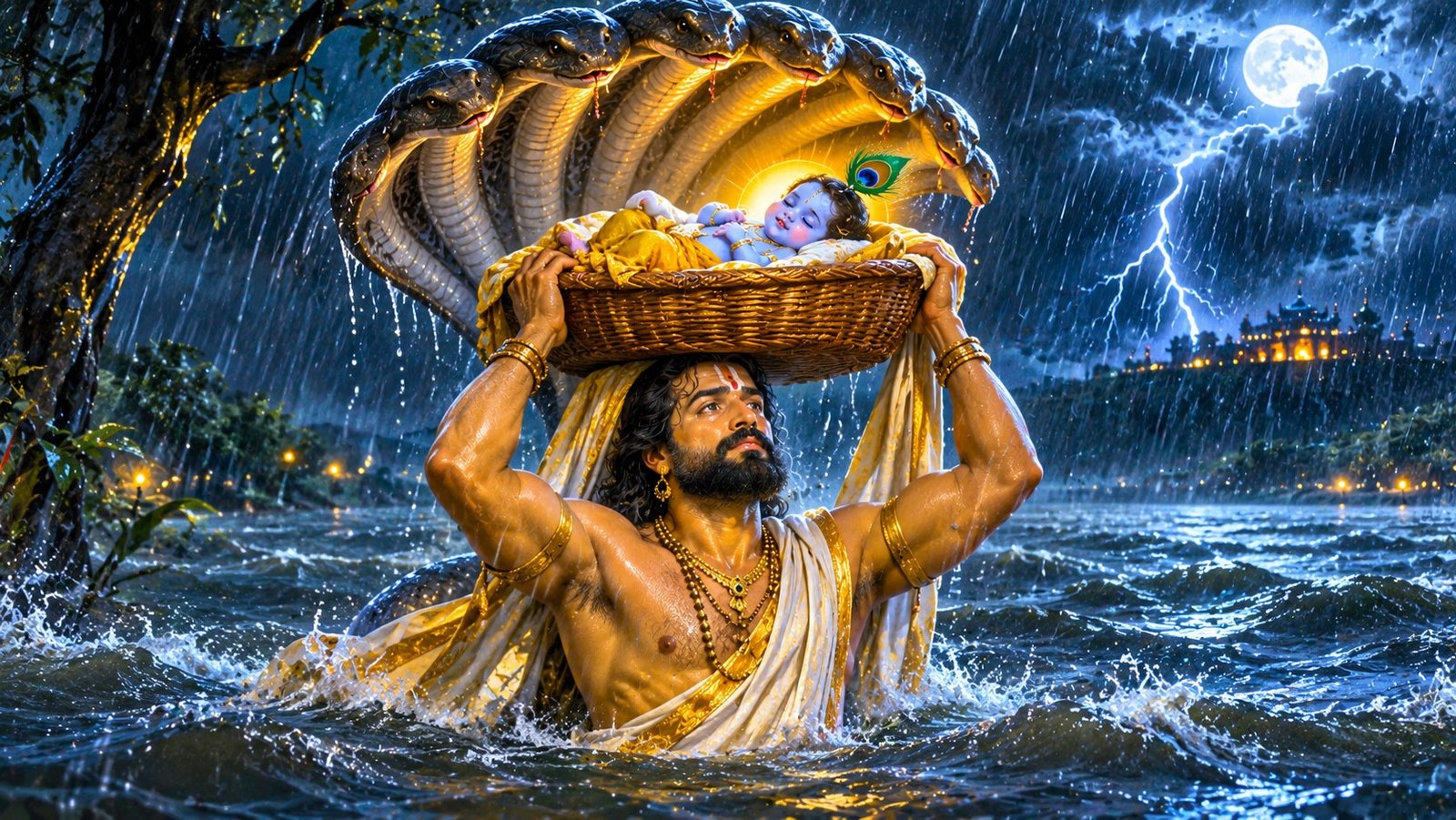
Vasudeva crosses the Yamuna
Vasudeva placed the baby in a basket and set out toward Gokul, where the cowherd chief Nanda and his wife Yashoda lived. Rain fell heavily, and the Yamuna was swollen. In devotional art and storytelling, the scene is often shown with Vasudeva wading through the river while holding the basket above his head. The serpent Shesha, also called Ananta in many traditions, is sometimes described as spreading his hoods above the child to shelter him from the rain.
The river crossing is one of the most beloved scenes in Krishna's birth story. The waters are described as parting or lowering enough to let Vasudeva pass, though versions differ in how this miracle unfolds. The imagery conveys that the journey was protected by divine grace. It also honours Vasudeva's resolve: he continues forward through darkness and uncertainty, guided by love and a duty greater than his own safety.
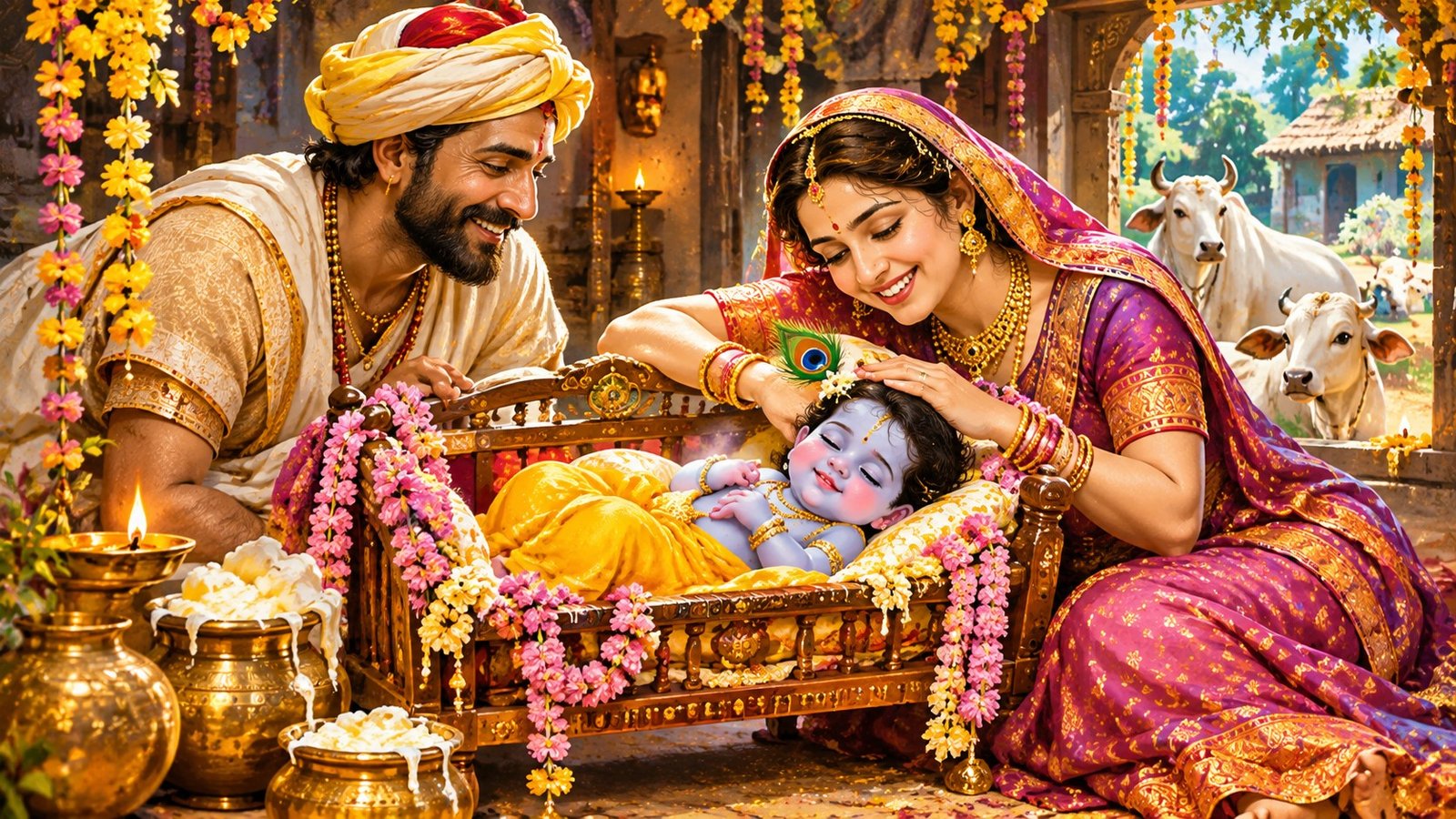
When Vasudeva reached Gokul, he came to Nanda Raja’s home, where Yashoda had given birth to a daughter. In the familiar Puranic telling, Yashoda was resting after childbirth and did not fully realize what had happened. Vasudeva gently placed the infant Krishna beside her, took the newborn girl, and began the dangerous journey back to Mathura. He crossed the Yamuna once more and returned to the very prison from which he had escaped. As he entered, the prison doors closed and his chains and the guards’ watch were restored in the miraculous account. When the guards awoke, they heard the baby crying and informed Kansa. Krishna, meanwhile, remained in Nanda and Yashoda’s care, surrounded by the cowherd community of Gokul.
Kansa's plan is challenged
When Kansa learned that a child had been born in the prison, he came to take the infant, still determined to defeat the prophecy. But the child was not the boy he expected. In many versions, the girl slipped from his grasp and revealed a divine form, warning that the one destined to end his tyranny was already beyond his reach. She is identified in different traditions with Yogamaya or a divine goddess, and the details vary across texts and regional retellings.
Kansa's fear did not disappear. Instead, he ordered the search for children who might be Krishna and sent dangerous beings to find and kill the child. This leads into the later stories of Krishna's childhood, including the encounter with Putana and other threats. Krishna, meanwhile, grew up in Gokul and Vrindavan, loved by Yashoda and Nanda and cherished by the people of Vraja.
The story does not end with Kansa's immediate defeat. It begins a longer narrative in which Krishna's childhood play, acts of protection and eventual return to Mathura gradually bring the prophecy to its fulfilment. The birth episode is therefore both a complete tale of rescue and the opening of a much larger cycle of Krishna Leela.
Meaning and lessons of Krishna's birth
For devotees, Krishna's birth signifies the arrival of divine presence when injustice and fear seem powerful. The story is often connected with the broader Hindu idea that dharma—the sustaining order of truth, responsibility and right conduct—must be protected when it is threatened. Krishna's later teaching in the Bhagavad Gita gives this theme a philosophical expression, while the birth story presents it through family, danger and miraculous deliverance.
Vasudeva's journey offers a lesson in responsible courage. He cannot control the storm, the river or Kansa's decisions, but he can take the next necessary step to protect the child. Devaki and Vasudeva's endurance also reminds readers that hope may survive even when circumstances appear closed and oppressive. Their faith is not portrayed as passivity: Vasudeva acts, chooses a route and accepts risk.
Kansa's role offers a cautionary lesson. He tries to escape a feared future by using violence, yet his cruelty creates suffering and deepens his own fear. The story invites reflection on how power becomes destructive when it is driven by insecurity rather than justice. In devotional interpretation, the divine child cannot be defeated by worldly control; in a broader ethical reading, fear does not excuse the harm a ruler inflicts on others.
Janmashtami is celebrated in many communities through fasting, prayer, devotional singing, readings of Krishna's birth, temple decorations and the midnight observance associated with his appearance. Customs differ by region and lineage. The festival is not only a remembrance of a sacred event but also an invitation to welcome qualities associated with Krishna—compassion, wisdom, joy and the protection of dharma—into everyday life.
Reflection
The birth of Shri Krishna teaches that hope can appear in the darkest hour, that courage often means taking one careful step at a time, and that power without justice eventually harms both the ruler and the people. Read as a sacred narrative, it celebrates divine protection; read as a moral story, it asks us to meet fear with responsibility rather than cruelty.