
A Ramayana Story with a Lesson
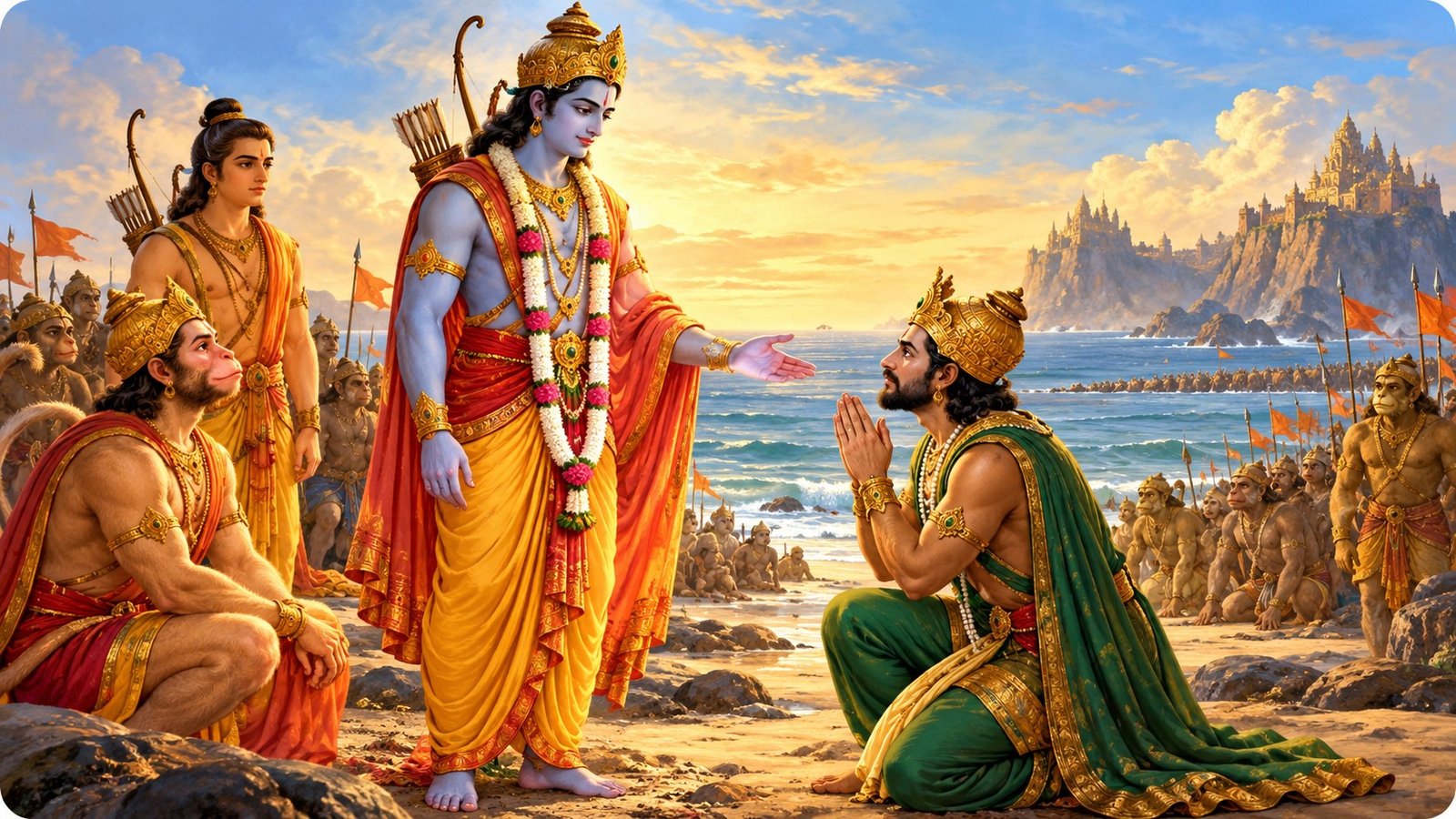
Vibhishana's Surrender to Lord Rama: Choosing Dharma Over Family Loyalty
A story from the Yuddha Kanda of the Valmiki Ramayana about moral courage, refuge, and the choice to stand with righteousness.
The central lesson
True loyalty cannot require us to support what we know to be wrong.
Vibhishana's choice invites us to consider how conscience, courage and compassion can guide us when family loyalty and dharma appear to conflict.
1. A Brother Who Spoke Against Adharma
Vibhishana was Ravana's younger brother and a member of Lanka's royal family. When Ravana abducted Sita, the wife of Lord Rama, Vibhishana urged him to reconsider his actions and return her to Rama. He understood that keeping Sita against her will was not a path that could bring lasting honour or security to Lanka.
Vibhishana did not remain silent simply because Ravana was powerful or because the matter involved his own family. He spoke openly in the royal court, advising his brother to choose a wiser and more righteous course.
Ravana rejected this counsel. As the conflict deepened, Vibhishana faced a painful choice: continue serving his brother despite his conduct, or leave the kingdom and stand by his understanding of dharma.
2. The Difficult Decision to Leave Lanka
After his advice was rejected and he was treated with hostility, Vibhishana left Lanka with companions who accompanied him. He travelled to Rama's camp, where Rama and the vanara leaders were preparing for the campaign to recover Sita.
His arrival created uncertainty among Rama's allies. Could Ravana's own brother be trusted? Was he genuinely seeking refuge, or might his arrival be a strategy to learn the army's plans? The leaders considered these concerns before deciding what to do.
The episode recognises that trust can require careful judgement. Vibhishana's family connection to Ravana raised questions, but it did not by itself settle the question of his intentions.
3. Rama's Decision to Grant Refuge
Rama listened to the different views offered by his allies. Some were cautious about accepting a newcomer from the enemy's side. Rama, however, chose to receive Vibhishana, placing great importance on the duty to protect one who sincerely seeks refuge.
The episode is remembered as a powerful expression of Rama's character: he does not judge Vibhishana only by his birth or by his relationship to Ravana. He considers the act of seeking refuge and the moral commitment it represents.
In traditional tellings of the episode, Rama's resolve to protect a sincere supplicant becomes a central statement of his commitment to righteousness and compassion. Wording differs across translations and retellings, so this account paraphrases the episode rather than presenting a single translation as a verbatim quotation.
4. Standing with Rama
Vibhishana was accepted into Rama's camp and became an ally in the struggle against Ravana. His knowledge of Lanka and its ruler proved useful during the campaign. His decision was not merely a rejection of his brother; it was a commitment to a different course of action.
After Ravana's defeat, Rama supported Vibhishana's installation as king of Lanka. The ending reinforces the story's movement away from the misuse of power and toward responsible rule.
5. What Vibhishana's Story Teaches Us
- Conscience matters: family ties and social pressure do not remove our responsibility to question harmful actions.
- Courage can be quiet: Vibhishana first tried to persuade Ravana through counsel rather than immediately choosing conflict.
- Trust deserves discernment: Rama heard the concerns of his allies before making his decision.
- Compassion can coexist with wisdom: offering refuge is presented as a moral commitment, not as indifference to the risks involved.
- Leadership requires principles: power is best directed toward justice, responsibility and the welfare of others.
6. Applying the Lesson Today
In everyday life, we may face pressure to defend a relative, friend, colleague or leader even when we believe their actions are wrong. Vibhishana's story encourages us to speak honestly, seek a fair resolution and avoid confusing loyalty with unquestioning agreement.
It also reminds us not to condemn people solely because of their background or associations. We should consider their choices, listen carefully, and balance compassion with sound judgement.
The lesson is not that every disagreement requires separation. Vibhishana first offered counsel. His departure came after that counsel was rejected and the conflict over dharma continued. His story asks us to recognise when persuasion is possible—and when conscience requires a different stand.
Scriptural Source
Valmiki Ramayana, Yuddha Kanda: the episode of Vibhishana's arrival in Rama's camp and Rama's deliberation about granting him refuge. Chapter and verse numbering may differ among editions and translations.
This article presents a concise retelling and modern reflections. Readers should consult a complete translation for the full narrative and its textual context.